The Redwood Coast is not known for enormous, high-volume waterfalls like those found in some mountain regions. Its waterfalls are usually more intimate, appearing as forest cascades, seasonal streams, and rain-fed water moving through the redwoods toward the Pacific.
The experience is often less about seeing one massive waterfall and more about entering a landscape shaped by water. Rain supports the redwoods. Creeks feed the rivers. Fog collects on trees and vegetation. Small streams travel through fern-covered forest before eventually reaching the Pacific Ocean.
The region's waterfall experiences may include forest cascades flowing over mossy rocks, small waterfalls hidden among ferns, creeks descending toward secluded beaches, seasonal streams spilling over coastal cliffs, rain-fed cascades beside forest trails, and water moving through shaded redwood ravines.
Two named waterfall destinations stand out for White Rock Resort guests: Fern Falls, reached by the Boy Scout Tree Trail in Jedediah Smith Redwoods State Park, and Trillium Falls, reached from the Elk Meadow Day Use Area near Prairie Creek.
Visitors may also encounter smaller seasonal cascades along coastal trails and secluded beaches near Crescent City, Brookings, and Samuel H. Boardman State Scenic Corridor. This guide explains where to find the region's best waterfall experiences, when to visit, what trail conditions to expect, and how to enjoy them safely.
Are There Large Waterfalls Near Crescent City?
Travelers should begin with realistic expectations. The immediate Crescent City and Brookings area does not contain a large collection of famous, towering waterfalls directly beside the highway. The best-known local falls are relatively small forest cascades.
Their appeal comes from the setting:
- Old-growth redwoods.
- Fern-covered ravines.
- Mossy rocks.
- Flowing creeks.
- Quiet forest.
- Rain and mist.
- Wildlife habitat.
Fern Falls and Trillium Falls may not impress visitors through height alone. They become memorable because of the journey through the redwoods.
Which Waterfalls Should You Prioritize?
For most visitors, the two strongest waterfall choices are Fern Falls and Trillium Falls. They offer very different experiences.
Fern Falls
Located at the end of the Boy Scout Tree Trail in Jedediah Smith Redwoods State Park.
Best for:
- Guests staying near Crescent City.
- Experienced hikers.
- Old-growth redwood scenery.
- A half-day forest adventure.
- Travelers with a smaller vehicle.
Trillium Falls
Located near Elk Meadow, north of Orick.
Best for:
- Families with older children.
- Visitors combining waterfalls with Roosevelt elk viewing.
- Travelers who want easier trailhead access.
- Guests driving south toward Prairie Creek.
- Visitors who prefer a shorter waterfall option.
Fern Falls
Fern Falls is the closest well-established waterfall hike for many White Rock Resort guests. It lies at the end of the Boy Scout Tree Trail in Jedediah Smith Redwoods State Park. The National Park Service describes the Boy Scout Tree Trail as a roughly 5.5-mile round-trip hike through old-growth redwoods and riparian habitat, ending at the base of Fern Falls. The trail is considered a moderate hike and should generally be treated as a half-day experience.
The waterfall itself is only part of the experience. The journey through the redwoods is what makes this outing memorable.
Why Fern Falls Is Worth Visiting
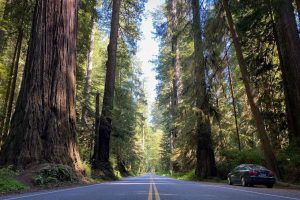
Fern Falls itself is a modest forest waterfall. The trail is the larger attraction. The route passes through:
- Old-growth redwood forest.
- Fern-covered ground.
- Shaded creek habitat.
- Fallen trees.
- Moist ravines.
- Dense green vegetation.
- Some of the most impressive trees near Crescent City.
California State Parks notes that the waterfall is pleasant, but the old-growth forest encountered along the way is even more impressive. Visitors should think of Fern Falls as the destination at the end of a remarkable redwood journey.
Boy Scout Tree Trail Distance
The official trail information places the round-trip distance at approximately:
This is not a short roadside waterfall walk. Visitors should be prepared for:
- Several hours of hiking.
- Uneven forest trail.
- Roots.
- Mud.
- Elevation changes.
- Moist conditions.
- Limited facilities once on the trail.
The hike may take longer than expected because most visitors stop frequently to photograph the redwoods.
How Difficult Is the Boy Scout Tree Trail?
The National Park Service classifies the route as a moderate hike. However, difficulty depends on:
- Fitness.
- Weather.
- Trail moisture.
- Footwear.
- Number of stops.
- Children's ages.
- Daylight.
- Experience on uneven trails.
Some visitors may find the distance and muddy terrain more demanding than the word "moderate" suggests.
Reaching the Boy Scout Tree Trail
The trailhead is reached from Howland Hill Road. Howland Hill Road is:
- Narrow.
- Primarily unpaved.
- Surrounded by large redwoods.
- Unsuitable for RVs and trailers.
- Better for standard passenger vehicles.
- Slower after rain.
The National Park Service specifically describes Fern Falls as a practical option for visitors near Crescent City who have a smaller vehicle and cannot or do not want to drive farther south to other redwood trails.
Visitors with RVs, trailers, oversized trucks, or wide vans should not assume they can reach the trailhead comfortably.
Parking at the Boy Scout Tree Trail
Parking may be limited. Before departure:
- Confirm the road is open.
- Arrive early.
- Use only legal spaces.
- Do not block Howland Hill Road.
- Do not park against redwood trees.
- Do not obstruct emergency access.
- Be prepared to return later if parking is full.
The trailhead has limited amenities compared with more developed areas.
What Is the Boy Scout Tree?
The trail is also known for the Boy Scout Tree, a large double redwood reached by a short spur from the main route. The tree is not the official end of the trail. Fern Falls lies farther along.
Visitors should:
- Follow official signs.
- Carry a map.
- Note the route back.
- Avoid unofficial side paths.
- Allow enough time to reach the waterfall and return.
What Does Fern Falls Look Like?
Fern Falls is a small forest cascade surrounded by:
- Ferns.
- Moss.
- Rocks.
- Fallen wood.
- Dense vegetation.
Its appearance changes according to rainfall. After wet weather, it may flow more strongly. During drier periods, the waterfall may be considerably lighter. This seasonal variation is natural.
Do Not Climb Around Fern Falls
The National Park Service specifically warns visitors not to climb on or near the waterfall because doing so can damage habitat and create a safety risk.
Wet rocks may be:
- Slippery.
- Covered in moss.
- Unstable.
- Hidden beneath water.
- Difficult to descend safely.
Stay on the Established Trail
Remain on the established trail and viewing area. Do not move onto wet rocks or climb around the cascade for a better photograph.
Best Time to Visit Fern Falls
Fern Falls may be most attractive during:
- Winter.
- Spring.
- Periods following moderate rainfall.
- Cool, overcast mornings.
- Times when the forest remains moist.
Summer can still be beautiful, although water volume may be lower.
Avoid the trail during:
- High-wind warnings.
- Severe storms.
- Flooding.
- Road closures.
- Dangerous forest conditions.
Trillium Falls
Trillium Falls is one of the best-known waterfall hikes within Redwood National and State Parks. The trail begins at Elk Meadow Day Use Area, just off Davison Road, approximately three miles north of Orick.
The National Park Service describes the waterfall route as a ranger favorite through old-growth redwoods. The full loop is approximately 2½ to 3 miles, while a shorter out-and-back hike can reach the waterfall and return without completing the entire loop.
Why Trillium Falls Is a Strong Choice
Trillium Falls combines:
- A forest waterfall.
- Old-growth redwoods.
- Developed parking.
- Picnic tables.
- Restrooms.
- Drinking water.
- Possible Roosevelt elk sightings.
- Flexible hiking distance.
The National Park Service states that many rangers recommend it as one of the best shorter hikes in Redwood National and State Parks because of its scenery, parking, and trailhead facilities.
What Is Available at Elk Meadow?
Elk Meadow Day Use Area provides:
- Parking for vehicles of many sizes.
- Picnic tables.
- Flush toilets.
- Drinking water.
- Information.
- Access to connected trails.
Official park information indicates that buses, RVs, and trailers can use the parking area. This makes Trillium Falls more practical than Fern Falls for travelers in larger vehicles.
Trillium Falls Trail Distance
Shorter Out-and-Back
A roughly one-mile round trip may allow visitors to reach the waterfall area and return, depending on the exact route used and current trail configuration.
The National Park Service has offered ranger-led hikes described as approximately one mile out and back to the falls.
Full Loop
The full route is approximately 2½ miles according to some official park planning information and roughly 3 miles when completed as the broader loop.
Trail distance can vary depending on the connecting paths selected.
How Difficult Is Trillium Falls Trail?
The shorter waterfall walk may be manageable for many active visitors. The complete loop may involve:
- Moderate climbing.
- Forest roots.
- Mud.
- Uneven surfaces.
- Narrow trail.
- Slippery sections.
- Longer walking time.
The trail is not fully accessible for wheelchairs or visitors who cannot manage uneven forest terrain.
Roosevelt Elk at Elk Meadow
Visitors may encounter Roosevelt elk near the parking area or adjacent meadow. Official park information notes that there is a good chance of seeing one of the park's elk herds near Elk Meadow.
If elk are present:
- Remain at least 25 yards away.
- Keep children close.
- Keep pets secured.
- Do not walk into the meadow.
- Do not approach calves.
- Do not block the herd.
- Use binoculars.
- Remain especially cautious during calving season and the fall rut.
A waterfall outing can quickly become a wildlife-viewing experience.
What Does Trillium Falls Look Like?
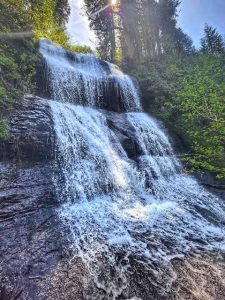
Trillium Falls is a small, multi-level cascade moving through moss-covered rocks in the redwood forest. Its beauty comes from the combination of:
- Flowing water.
- Ferns.
- Moss.
- Old-growth trees.
- Forest shade.
- Fallen logs.
- Moist air.
It is not a towering free-falling waterfall. Photographers often capture the water as a soft cascade moving through dark green forest.
Best Time to Visit Trillium Falls
The falls may have stronger flow during:
- Winter.
- Spring.
- Rainy periods.
- The weeks following sustained rainfall.
Spring may also bring:
- Wildflowers.
- Fresh fern growth.
- Bright green moss.
- Active creeks.
- Changing elk behavior.
Summer usually provides longer daylight and drier trail conditions, but there may be more visitors and potentially lighter waterfall flow.
Fern Falls Versus Trillium Falls
Choose Fern Falls When:
- You are staying near Crescent City.
- You want a longer hike.
- You have a smaller vehicle.
- You are comfortable on Howland Hill Road.
- The old-growth forest is the main priority.
- You have at least half a day.
Choose Trillium Falls When:
- You want easier parking.
- You are driving south toward Orick.
- You want restrooms and picnic tables.
- You want a shorter waterfall option.
- You are traveling in an RV or larger vehicle.
- You want a chance to see Roosevelt elk.
- You are combining the hike with Prairie Creek.
Which Waterfall Is Better for Families?
For many families, Trillium Falls is the more practical choice because it offers:
- Developed parking.
- Restrooms.
- Picnic tables.
- A shorter out-and-back option.
- Flexible trail distance.
- Nearby elk habitat.
Fern Falls may be appropriate for older children, experienced hiking families, children comfortable walking more than five miles, and families prepared for mud and uneven terrain.
Young children should not be expected to complete the Boy Scout Tree Trail without careful planning.
Which Waterfall Is Better for Serious Hikers?
Fern Falls and the Boy Scout Tree Trail generally provide the more substantial hiking experience. The trail offers:
- Greater distance.
- More remote forest.
- Deeper old-growth scenery.
- A stronger sense of exploration.
- Fewer developed facilities.
The waterfall itself should not be the only reason for the hike.
Which Waterfall Is Better for RV Travelers?
Trillium Falls is generally the better option. The Elk Meadow trailhead provides parking for vehicles of many sizes, including RVs and trailers.
The Boy Scout Tree trailhead requires travel on Howland Hill Road, which is not appropriate for large vehicles.
Seasonal Coastal Cascades Near Brookings
The Brookings coast may develop small seasonal cascades after sustained rain. These may appear where:
- Creeks cross beaches.
- Water descends coastal bluffs.
- Forest streams reach the Pacific.
- Drainage channels spill over rocks.
- Rainwater moves through coves.
Samuel H. Boardman State Scenic Corridor contains twelve miles of rocky shoreline, secluded beaches, headlands, trailheads, and an eighteen-mile segment of the Oregon Coast Trail.
Visitors may sometimes notice unnamed or lightly flowing cascades within this coastal landscape. These should be treated as seasonal natural features rather than guaranteed destinations.
Secret Beach and Seasonal Water
The area commonly referred to as Secret Beach may contain a small creek or seasonal cascade flowing toward the beach during wet periods. However:
- Flow varies.
- Access can be steep.
- Trails may be muddy.
- Beach conditions depend on tide.
- Informal paths may be unsafe.
- The waterfall may be minimal during dry weather.
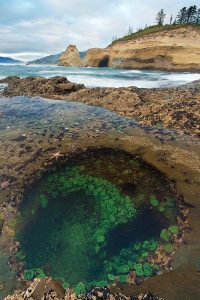
Secret Beach should be visited primarily for coastal scenery, sea stacks, beach exploration, and photography. Any cascade should be considered a seasonal bonus.
Do Not Follow Unofficial Coastal Trails
Online photographs sometimes show people standing beneath cliffside cascades or crossing steep slopes. That does not mean the route is safe or authorized.
Along the Brookings coast:
- Use official trailheads.
- Remain on established trails.
- Avoid cliff edges.
- Do not descend eroded slopes.
- Do not cross barriers.
- Check tides.
- Avoid incoming surf.
- Do not enter narrow coves when the tide is rising.
Waterfalls at Beaches
A beach waterfall may seem easy to reach once it becomes visible. However, access may involve:
- Slippery boulders.
- Rising tide.
- Loose rock.
- Unstable cliffs.
- Driftwood.
- Strong waves.
- Narrow escape routes.
Never walk around a headland without knowing:
- The current tide.
- The next high tide.
- Whether the route remains open.
- Whether waves are reaching the rocks.
- How quickly you can return.
Enderts Beach and Coastal Creeks
Enderts Beach near Crescent City is reached by a roughly half-mile descent from the parking area. The National Park Service describes it as a rugged beach with tide-pooling opportunities and notes that access trails can be affected by rockfall or closures. The route also crosses the Nickel Creek area before descending approximately 200 feet toward the beach.
While Enderts Beach is not promoted as a primary waterfall destination, visitors may encounter:
- Flowing creeks.
- Wet cliffs.
- Rain-fed drainage.
- Small seasonal cascades.
The main reasons to visit remain coastal scenery, tide pools, beach walking, and ocean views.
Waterfall Flow by Season
Winter
Advantages:
- Stronger creek flow.
- Lush moss.
- Dramatic forest atmosphere.
- Fewer visitors.
Challenges:
- Heavy rain.
- Mud.
- Fallen branches.
- Short daylight.
- Flooding.
- High winds.
- Road closures.
Spring
Advantages:
- Good waterfall flow.
- Bright vegetation.
- Wildflowers.
- Longer daylight.
- Moderate temperatures.
Challenges:
- Mud.
- Unpredictable rain.
- Wet roots.
- Calving elk near some trailheads.
Summer
Advantages:
- Drier trails.
- Longer daylight.
- Easier driving.
- More predictable weather.
Challenges:
- Reduced waterfall flow.
- More visitors.
- Limited parking.
- Dust on unpaved roads.
Fall
Advantages:
- Quieter trails.
- Early rain may restore creek flow.
- Atmospheric fog.
- Changing forest light.
Challenges:
- Unpredictable storms.
- Shortening daylight.
- Elk rut near prairie areas.
- Slippery leaves and roots.
Is Rain the Best Time to See Waterfalls?
Recent rainfall often improves waterfall flow. That does not mean visitors should hike during a severe storm.
A good waterfall day may occur:
- After rain has stopped.
- During light rain.
- When wind is low.
- When roads remain open.
- When creeks are not flooding.
- When daylight is adequate.
Avoid forest hiking during high-wind warnings because branches and trees may fall.
Waterfall Safety
Waterfalls create several hazards. These include:
- Slippery rock.
- Moss-covered surfaces.
- Strong creek flow.
- Unstable banks.
- Falling branches.
- Mud.
- Hidden drop-offs.
- Cold water.
- Flashier runoff after storms.
Stay on the Trail
Stay on the trail. Avoid climbing around falls. Keep children beside adults. Wear shoes with traction. Carry rain protection. Turn back when conditions become unsafe. Respect closures. Avoid stream crossings during high water.
Why Rocks Near Waterfalls Are Dangerous
Rocks beside a waterfall may appear dry from a distance but may be coated with:
- Fine spray.
- Moss.
- Algae.
- Wet leaves.
- Mud.
- Loose gravel.
One step may cause a fall. Do not stand on logs above the creek, wet boulders, the edge of a cascade, beneath unstable banks, or in flowing water.
The safest photograph is usually taken from the established trail.
Do Not Enter Waterfall Pools
Small forest pools may be:
- Extremely cold.
- Deeper than they appear.
- Filled with submerged branches.
- Surrounded by slippery rocks.
- Ecologically sensitive.
Swimming is not part of the Fern Falls or Trillium Falls experience. Observe from the trail.
Waterfall Photography
Waterfall photography works especially well in overcast forest conditions. Clouds reduce harsh contrast between bright water, dark trees, reflective rocks, and deep shadows.
Useful equipment may include:
- Camera.
- Tripod.
- Polarizing filter.
- Rain cover.
- Lens cloth.
- Extra battery.
- Microfiber towel.
- Waterproof bag.
Creating Soft Waterfall Images
Photographers often use slower shutter speeds to make water appear smooth. This works best when:
- The camera is stable.
- The photographer remains on the trail.
- A tripod does not block other visitors.
- Exposure is adjusted carefully.
- Spray is kept off the lens.
Do not move onto wet rocks merely to improve the composition.
Waterfall Photography With a Smartphone
A smartphone can produce strong waterfall photographs. Try:
- Using the normal lens rather than extreme digital zoom.
- Cleaning the lens first.
- Including redwoods and ferns.
- Holding the phone securely.
- Taking several exposures.
- Photographing vertical and horizontal compositions.
- Using a stable railing or natural stance.
Protect the phone from rain, creek water, mud, drops, and condensation.
Photograph the Setting
The waterfall may be only one part of the scene. Include:
- Redwood trunks.
- Ferns.
- Moss.
- Forest trail.
- Bridge.
- Creek.
- Family members at a safe distance.
- Light entering the canopy.
A wider photograph may better communicate the scale and atmosphere of the redwood forest.
Visiting Waterfalls With Children
Before the hike, explain:
- Waterfall rocks are slippery.
- Children must remain on the trail.
- No one may climb logs.
- No one may enter the creek.
- Adults determine when to turn around.
- Wildlife should remain undisturbed.
Bring:
- Snacks.
- Water.
- Layers.
- Rain jacket.
- Extra socks.
- Small towel.
- First-aid supplies.
- Child carrier when appropriate.
Waterfall Scavenger Hunt
Children may look for:
- Flowing water.
- A fern.
- Moss.
- A fallen redwood.
- A bridge.
- A bird call.
- A banana slug.
- A redwood cone.
- A creek.
- Something growing on a log.
Everything should remain where it is found.
Waterfalls With Toddlers
Fern Falls is generally too ambitious for many toddlers unless carried by a capable adult prepared for a long forest hike. Trillium Falls may be more practical, but the trail remains uneven.
For toddlers:
- Use a secure child carrier.
- Avoid strollers.
- Keep the outing short.
- Visit in stable weather.
- Bring extra clothing.
- Turn back before the child becomes exhausted.
- Keep away from elk at Elk Meadow.
Waterfalls for Older Adults
Older travelers should evaluate:
- Distance.
- Elevation.
- Mud.
- Roots.
- Balance.
- Restroom access.
- Vehicle access.
- Ability to turn around.
Trillium Falls is generally more practical because:
- The trailhead has facilities.
- Parking is developed.
- A shorter route is possible.
- Visitors do not have to complete the full loop.
Accessibility
Neither Fern Falls nor Trillium Falls should be considered fully wheelchair-accessible waterfall destinations. Trillium Falls offers better trailhead facilities, but the forest trail itself includes uneven natural terrain.
Visitors unable to hike may still enjoy:
- Elk Meadow.
- Picnic areas.
- Redwood drives.
- Prairie Creek visitor areas.
- Smith River viewpoints.
- Coastal overlooks.
- Rain-fed roadside scenery viewed from legal pullouts.
Accessibility and trail conditions should be confirmed before departure.
Waterfalls With Dogs
Pet rules vary by park and trail. Dogs are generally not permitted on many trails within Redwood National and State Parks.
Before leaving White Rock Resort:
- Check the specific trail rule.
- Do not assume a leash makes the trail pet-friendly.
- Never leave a dog unattended in a vehicle.
- Keep dogs away from elk.
- Avoid wildlife habitat.
- Choose a legal pet-friendly alternative when necessary.
The Boy Scout Tree Trail and Trillium Falls Trail should not be planned as dog walks without verifying current park regulations.
What to Wear
Recommended clothing includes:
- Waterproof hiking shoes.
- Shoes with strong traction.
- Moisture-resistant layers.
- Rain jacket.
- Warm mid-layer.
- Hat.
- Extra socks.
Avoid:
- Flip-flops.
- Smooth-soled shoes.
- Heavy cotton clothing in cold rain.
- Clothing that restricts movement.
Forest temperatures may feel cooler than conditions at White Rock Resort.
What to Pack
For Fern Falls, carry enough water and food for a half-day outing.
Trail Maps and Navigation
Mobile service may be weak or absent. The National Park Service recommends using reliable maps because GPS navigation can be unreliable within Redwood National and State Parks.
Before leaving:
- Download the park map.
- Screenshot directions.
- Note trail junctions.
- Confirm the return route.
- Carry a paper map.
- Tell someone where you are going.
Do not rely solely on a phone signal.
Check Current Conditions
Conditions may change because of:
- Storm damage.
- Fallen trees.
- Flooding.
- Rockfall.
- Road work.
- Mud.
- Fire.
- Trail maintenance.
- Wind warnings.
- Seasonal closures.
Official park resources provide current information about closures, trail conditions, delays, and other alerts. Check conditions on the morning of the hike.
Half-Day Fern Falls Itinerary
Allow extra time for the narrow drive and limited parking.
Trillium Falls Day
This itinerary combines waterfalls, wildlife, and scenic driving.
Sample Family Waterfall Day
Avoid adding too many additional hikes.
Sample Photography Day
Sample Rainy-Day Waterfall Plan
Do not hike during high-wind warnings or severe storms.
Sample Two-Day Waterfall Plan
This allows visitors to experience both the northern and southern redwood environments without rushing.
Questions to Ask Before Visiting a Waterfall
- Is the trail open?
- Is the access road open?
- Is my vehicle suitable?
- Has recent rain caused flooding?
- Are high winds expected?
- How long is the hike?
- Is the trail muddy?
- Are restrooms available?
- Is parking limited?
- Are RVs permitted?
- Are pets permitted?
- Is the route suitable for children?
- Is the trail accessible?
- Is mobile service available?
- When does darkness begin?
- Are elk present near the trailhead?
- Is the waterfall currently flowing?
- Are bridges or stream crossings damaged?
- Are ranger programs offered?
- What alternative should we use if the trail is closed?
Common Waterfall-Trip Mistakes
Expecting a Huge Waterfall
The region's waterfalls are generally small forest cascades.
Hiking Only for the Final Destination
The forest journey is often the highlight.
Driving a Large Vehicle to Fern Falls
Howland Hill Road and the Boy Scout Tree trailhead are not suitable for every vehicle.
Underestimating the Boy Scout Tree Trail
The hike is more than five miles round trip.
Climbing Beside the Waterfall
Wet rocks are dangerous and the habitat is fragile.
Visiting During High Winds
Branches and trees may fall.
Wearing Inappropriate Shoes
Use footwear with strong traction.
Depending on Cell Service
Download maps before leaving.
Promising Children an Easy Walk
Trail distance and terrain may be challenging.
Ignoring Elk Near Trillium Falls
Give all elk substantial space.
Walking to Coastal Cascades Without Checking Tides
Rising water may cut off the return route.
Following Unofficial Social-Media Paths
Use established trails.
Expecting Strong Summer Flow
Some falls and cascades become lighter in dry weather.
Starting Too Late
Forest darkness arrives earlier beneath dense trees.
Leaving Food or Trash
Pack out everything brought in.
Best Overall Waterfall Recommendation
Best Shorter Waterfall Experience
Trillium Falls
- Developed parking.
- Restrooms.
- Picnic tables.
- Flexible trail distance.
- Elk-viewing opportunities.
- Easy combination with Prairie Creek.
Best Waterfall Adventure Near Crescent City
Fern Falls
- A longer forest hike.
- Extraordinary old-growth redwoods.
- A quieter, more immersive experience.
- A half-day adventure close to Crescent City.
Why White Rock Resort Is a Strong Waterfall Base
White Rock Resort is positioned between the two principal waterfall areas. Guests can travel:
- South toward Crescent City and Jedediah Smith Redwoods State Park.
- Farther south toward Prairie Creek, Elk Meadow, and Trillium Falls.
- North toward Brookings and seasonal coastal cascades.
- Along the coast in search of rain-fed streams and secluded coves.
After a wet forest hike, guests can return to the resort to:
- Warm up.
- Dry clothing.
- Prepare dinner.
- Clean hiking shoes.
- Review photographs.
- Recharge equipment.
- Rest beside the coast.
A multi-night stay makes it easier to wait for the safest weather and strongest waterfall conditions.
Waterfalls Near Crescent City and Brookings
What is the closest named waterfall to Crescent City?
Fern Falls in Jedediah Smith Redwoods State Park is one of the closest established waterfall destinations.
How do you reach Fern Falls?
Fern Falls is reached by hiking the Boy Scout Tree Trail from Howland Hill Road.
How long is the Fern Falls hike?
The round trip is approximately 5.5 to 5.6 miles.
Is Fern Falls a large waterfall?
No. It is a modest forest waterfall surrounded by redwoods and ferns.
Is the Boy Scout Tree Trail difficult?
It is officially considered moderate, but the distance, mud, roots, and terrain may make it challenging for some visitors.
Can an RV reach the Fern Falls trailhead?
The trailhead is reached by Howland Hill Road, which is not suitable for RVs, trailers, or other oversized vehicles.
Where is Trillium Falls?
Trillium Falls begins from Elk Meadow Day Use Area north of Orick.
How long is the Trillium Falls hike?
The falls can be visited by a shorter out-and-back route, while the full loop is approximately 2½ to 3 miles.
Is Trillium Falls good for families?
It is generally the more practical family waterfall because of its facilities and shorter route options.
Can RVs park at Trillium Falls?
Yes. The Elk Meadow parking area accommodates vehicles of many sizes, including RVs and trailers.
Can visitors see elk near Trillium Falls?
Yes. Roosevelt elk may be present near Elk Meadow, although sightings are never guaranteed.
Are there waterfalls near Brookings?
Small seasonal cascades and creeks may appear along the coast after rain, particularly within rugged coastal areas. These are less predictable than Fern Falls and Trillium Falls.
Is Secret Beach a guaranteed waterfall destination?
No. Seasonal water flow varies, and visitors should go primarily for the coastal scenery.
When is the best season for waterfalls?
Winter and spring generally provide stronger flow, although weather and trail hazards must be considered.
Can waterfalls be visited during rain?
Light rain may be appropriate when wind is low and trails remain safe. Avoid severe storms and high-wind conditions.
Can visitors climb around the falls?
No. Remain on established trails and avoid wet rocks.
Are dogs permitted?
Pet rules vary, and many park trails do not permit dogs. Verify the specific trail before departure.
Are the waterfall trails accessible?
The natural trails to Fern Falls and Trillium Falls are not fully wheelchair accessible.
What should visitors bring?
Bring water, layers, rain protection, sturdy shoes, maps, food, a charged phone, and a first-aid kit.
What is the most important waterfall safety rule?
Remain on the established trail and never climb on wet rocks near the cascade.
Let the Forest Stay Wet
Do not postpone a waterfall hike simply because the forecast is overcast. Soft cloudy light may create the best conditions for:
- Photographing water.
- Seeing bright green moss.
- Avoiding harsh forest shadows.
- Experiencing quieter trails.
- Watching mist move through the trees.
The ideal day is often not during heavy rain. It is the calm morning after rain has passed, when the creeks are flowing, the forest is wet, and every fern appears newly washed.
Related Articles
Discover Redwood Forest Waterfalls From White Rock Resort
The waterfalls of the Redwood Coast are not defined by enormous height. They are defined by their surroundings. Fern Falls waits at the end of a long trail through the old-growth forest of Jedediah Smith Redwoods State Park. Trillium Falls flows through moss-covered rocks beneath the redwoods near Elk Meadow. Seasonal creeks descend toward beaches and coves along the Southern Oregon coast.
Each waterfall reflects the relationship between rain, forest, river, and ocean. Choose the route that matches your vehicle and abilities. Check current conditions. Wear appropriate footwear. Remain on established trails. Respect wildlife. Avoid climbing around waterfalls. Turn back when weather becomes unsafe.
From White Rock Resort, guests can explore quiet forest cascades, walk beneath some of the tallest trees on Earth, photograph water moving through ferns and moss, and return to a comfortable coastal cabin after a memorable day in the redwoods.
Explore Cabins & AvailabilityPlanning information should be verified with current official park, road, weather, tide, and destination sources before travel, especially for closures, trail access, surf conditions, wildlife restrictions, vehicle restrictions, and seasonal services.