Oceanfront, ocean-view, and beachfront cabins can sound interchangeable, but they can describe very different vacation experiences. Understanding the terminology before booking can help you choose the cabin that actually matches the view, access, privacy, comfort, and coastal experience you want.
When travelers search for a coastal cabin, they often encounter descriptions such as oceanfront, ocean view, beachfront, beach access, waterfront, partial ocean view, coastal view, and steps from the beach.
These phrases may sound similar, but they do not always describe the same experience. An oceanfront cabin may face the water but sit above a rocky shoreline without direct beach access. A beachfront cabin may sit directly beside a beach but have a limited view because of dunes, trees, or neighboring structures. An ocean-view cabin may offer beautiful scenery from farther away.
Understanding these differences is important because location terminology can affect the view, distance from the water, beach access, privacy, noise, safety, price, weather exposure, and overall vacation experience.
This guide explains the most common coastal lodging terms and the questions travelers should ask before reserving a cabin.
Why Coastal Lodging Terms Can Be Confusing
There is no single universal definition used by every hotel, resort, vacation-rental company, or booking platform. Descriptions may vary according to property type, local geography, marketing practices, building orientation, distance from the shoreline, available views, type of beach, vegetation, elevation, and nearby buildings.
One property may use “oceanfront” only for accommodations directly facing the ocean. Another may use the term for any cabin located on the ocean side of the property.
Booking Tip
Never rely on a single category name. Review photographs, maps, the full accommodation description, and the physical access route before making a reservation.
What Does Oceanfront Mean?
An oceanfront cabin is generally located at or near the edge of the property facing the ocean. It usually has a more direct relationship with the water than an ocean-view cabin.
An oceanfront cabin may offer:
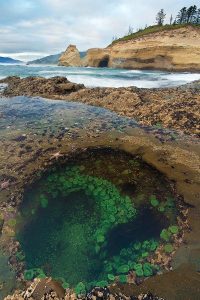
However, oceanfront does not automatically mean the cabin sits on a sandy beach. The shoreline may include rocks, cliffs, bluffs, driftwood, gravel, vegetation, seawalls, protected habitat, or a beach located below the cabin.
The cabin may face the ocean without providing direct or safe water access.
What Does Ocean View Mean?
An ocean-view cabin generally provides a visible view of the ocean from at least one part of the accommodation. The cabin may be behind an oceanfront building, higher on a hillside, farther inland, angled toward the water, located across a road, or partially obstructed by trees or other structures.
An ocean view may be visible from a deck, living-room window, bedroom, kitchen, one corner of the property, or an outdoor common area.
The size and quality of the view can vary significantly. One ocean-view cabin may offer a wide, uninterrupted panorama. Another may provide only a narrow glimpse between buildings or trees.
What Does Beachfront Mean?
A beachfront cabin is generally located directly beside or immediately adjacent to a beach. Beachfront usually describes physical proximity and access rather than the quality of the view.
What It May Provide
- Direct access to sand
- A short walk to the shoreline
- Few or no roads to cross
- Easy beachcombing
- Convenient sunset walks
- Quick access for families
- Easy returns to the cabin
What It Does Not Guarantee
- A panoramic ocean view
- Safe swimming
- A private beach
- Year-round beach access
- Calm water
- A sandy shoreline at every tide
- Unobstructed windows
Dunes, vegetation, driftwood, fencing, or elevation may affect what guests can see from the cabin.
Oceanfront and Beachfront Are Not Always the Same
Oceanfront
- Faces or directly relates to the ocean
- May sit above rocks or a bluff
- Can provide exceptional views
- May have stronger surf and wind exposure
- May not have sandy beach access
Beachfront
- Usually emphasizes immediate beach proximity
- May provide convenient shoreline access
- Can be affected by dunes or vegetation
- May have a limited ocean view
- Does not automatically mean private beach access
A cabin can be oceanfront without being beachfront—for example, if it is located on a bluff, above a rocky shoreline, beside a seawall, or near protected habitat.
A cabin can also be beachfront without having a full ocean view—for example, if it is behind dunes, surrounded by vegetation, positioned sideways to the water, or partially blocked by another cabin.
Waterfront, Partial Ocean View, and Direct Beach Access
Waterfront
Waterfront is a broader term. A waterfront cabin may sit beside the ocean, a bay, harbor, river, lake, lagoon, or estuary. A waterfront listing is not necessarily oceanfront or beachfront.
Partial Ocean View
A partial ocean view generally means the ocean is visible but the view is limited by trees, cabins, rooflines, fences, dunes, landscaping, terrain, or other structures.
Unobstructed Ocean View
This generally means there are no major permanent structures blocking the line of sight, although fog, rain, clouds, vegetation, rocks, or shoreline features can still affect visibility.
Steps From the Beach
This is a marketing phrase rather than a precise measurement. Ask for the actual walking distance, route, stairs, slope, and path conditions.
What Does Direct Beach Access Mean?
Direct beach access generally means guests can reach the beach from the property without driving elsewhere. The access route may involve a short path, gate, stairs, ramp, boardwalk, trail, or sloped walkway.
Direct access does not always mean easy access. Ask:
Private Beach Versus Direct Beach Access
A property may advertise direct access to a beach that is not legally private. In many coastal areas, public-access rights, tidal boundaries, and local laws affect shoreline use.
A “private beach” may mean the property owns adjoining land, access is limited through the resort, the beach feels secluded, few members of the public use it, or the access path is private. It may not mean that other people are legally prohibited from walking along the shoreline.
Travelers seeking complete privacy should ask how the property uses and defines the term.
Which Option Provides the Best View?
For travelers who value the view above all else, an oceanfront cabin with a clearly described unobstructed view is usually the safest choice. However, confirm which rooms face the ocean, whether the view is visible while seated, whether the deck faces the water, whether another building is below or beside the cabin, whether vegetation blocks part of the view, whether photographs were taken from the actual cabin, and whether seasonal foliage changes the view.
The best view is not determined by the category name alone.
Which Option Provides the Easiest Beach Access?
A beachfront cabin or cabin with direct beach access usually provides the most convenient route to the shoreline. This may be especially valuable for families with children, guests carrying chairs or coolers, beachcombers, photographers, older travelers, guests planning frequent walks, and travelers staying several nights.
Even so, review the physical route carefully. A cabin located above the beach may require a long staircase, while a slightly more distant cabin may have an easier level path.
Which Option Is Best for Families?
Families often benefit most from easy, visible beach access, a safe walking route, minimal traffic, a short distance to the cabin, outdoor space, practical parking, a kitchen, and enough sleeping space.
A beachfront cabin may be convenient, but safety remains important. Parents should consider exterior doors, proximity to cliffs or water, balcony design, stairs, driftwood hazards, surf conditions, and the need for constant supervision.
The closest cabin to the water is not automatically the safest choice.
Which Option Is Best for Couples?
Couples may value privacy, sunset views, wave sounds, a private deck, distance from parking areas, a comfortable interior, ocean-facing windows, and easy access to quiet walks.
An oceanfront cabin may create the strongest romantic atmosphere. However, an elevated ocean-view cabin may offer more privacy and a wider panorama than a lower beachfront cabin. Compare the specific cabin rather than choosing solely by category.
Which Option Is Best for Older Travelers or Guests With Limited Mobility?
Older guests may prefer minimal stairs, nearby parking, level walkways, safe railings, easy cabin access, comfortable outdoor seating, a view from inside, and short walking distances.
Accessibility should be evaluated separately from shoreline proximity. Ask whether there is step-free entry, whether the route from parking is level, whether the deck is accessible, whether the ocean can be viewed from inside, whether bathroom features meet your needs, whether beach access requires stairs, and whether the path is stable and paved.
A beachfront description does not imply wheelchair-accessible beach access. Sand, gravel, steep paths, and driftwood can make the shoreline difficult to reach.
Which Option Is Usually More Expensive?
Oceanfront and beachfront cabins often command higher rates because of limited availability, proximity to the water, direct views, beach access, greater demand, premium positioning, sunset exposure, and unique atmosphere.
However, price also depends on cabin size, number of bedrooms, amenities, season, day of the week, privacy, renovations, hot tubs, kitchens, and cancellation terms.
A smaller oceanfront cabin may cost less than a large ocean-view cabin designed for a family or group.
Is Paying More for Oceanfront Worth It?
It May Be Worth It When
- You plan to spend substantial time at the cabin.
- The view is a major reason for the trip.
- You are celebrating a special occasion.
- You value sunsets and wave sounds.
- Mobility limits sightseeing.
- You want the coast visible throughout the day.
- The stay is short and atmosphere matters.
It May Matter Less When
- You will be away exploring most of the day.
- Your budget is limited.
- The view is only partially visible.
- Beach access matters more than orientation.
- A nearby ocean-view cabin offers similar scenery.
- The premium reduces your ability to stay longer.
The value depends on how you expect to use the cabin.
Consider How Much Time You Will Spend Inside
The more time you plan to spend in the cabin, the more valuable a premium view may become. Oceanfront can be especially worthwhile for winter stays, storm watching, romantic trips, rest-focused vacations, older travelers, guests with young children, remote work combined with leisure, longer stays, and travelers who enjoy cooking and relaxing indoors.
Guests planning full days of hiking and sightseeing may be comfortable choosing a more affordable cabin with partial or distant ocean views.
Ocean Sounds, Wind, Fog, and Salt Air
An oceanfront or beachfront cabin may provide stronger wave sounds than a cabin farther away. Many guests find this relaxing, while others may find it loud during storms or difficult for light sleeping.
Cabins closest to the ocean may also be more exposed to strong wind, blowing rain, salt spray, cooler temperatures, rapid weather changes, sand, and storm noise.
Fog may hide distant views, move in and out quickly, create mist around the cabin, and change throughout the day. An oceanfront location does not guarantee a visible ocean every hour.
Cabins near the ocean also experience more exposure to salt air, humidity, mist, wind-driven rain, sand, and coastal moisture. These are common features of a true coastal environment.
Safety Near the Water
The closer a cabin is to the shoreline, the more important it is to understand local hazards. Potential risks include sneaker waves, strong currents, high tides, slippery rocks, unstable driftwood, cliff edges, erosion, storm surge, cold water, and limited visibility.
Never assume that direct access means the water is safe for swimming. Follow posted warnings and local guidance.
Cliff and Bluff Safety
Some oceanfront cabins sit above cliffs or bluffs. These locations may offer excellent views, but guests should avoid crossing barriers, standing near unstable edges, allowing children to play unsupervised, letting pets roam, climbing down unofficial paths, approaching eroded areas, or walking near edges during darkness or fog.
Use only designated paths and overlooks.
Beach Access May Change With the Tide
A beach that appears wide at low tide may become narrow or inaccessible at high tide. Before walking, review tide times, identify your return route, watch changing water levels, avoid being trapped around rocks or headlands, stay alert to surf, and return before access becomes unsafe.
Direct beach access does not guarantee that the entire shoreline can be used at every tide.
Examine Listing Photographs Carefully
Photographs can help clarify coastal terminology. Look for the view from inside the cabin, the view from the deck, the cabin exterior, nearby buildings, the path to the beach, shoreline type, stairs, roads, fences, trees, parking areas, and elevation.
Pay attention to captions. A photograph labeled “nearby beach” may not have been taken from the cabin or property.
Confirm That Photos Show the Actual Cabin
Some listings combine photographs from several accommodations. Ask whether the photographs are of the exact cabin, whether the view shown is the actual view, which deck is shown, whether the beach is visible from inside, whether images are from common areas, whether a zoom lens was used, and how current the photographs are.
Maps and Guest Reviews Can Reveal Important Details
Review property maps, satellite images, road maps, topographic information, and cabin-location diagrams. These may reveal distance from the water, cabin orientation, shoreline elevation, nearby roads, buildings between the cabin and ocean, parking locations, and walking routes.
Online maps may not show recent changes, so use them as one source rather than the final answer.
Guest reviews can explain what marketing descriptions do not. Look for comments about actual view quality, distance to the beach, stairs, noise, privacy, wind, fog, path conditions, parking, neighboring cabins, sunset visibility, and wave sounds. Give greater weight to recent reviews that identify the specific cabin.
Questions to Ask Before Booking
Clear questions reduce the risk of disappointment.
Compare the Entire Cabin, Not Just the View
The view is important, but it should not be the only booking factor. Also compare bed size, number of bedrooms, kitchen, bathroom, heating, seating, parking, Wi-Fi, pet policy, accessibility, outdoor space, cancellation policy, minimum stay, overall condition, and guest reviews.
The Best Cabin Is the Best Fit
A spectacular view does not compensate for a cabin that does not meet your basic sleeping, accessibility, comfort, parking, or space requirements.
Oceanfront Versus Ocean View
Oceanfront Cabin
- Closest orientation to the ocean
- Strong visual connection
- More wave sound
- Greater weather exposure
- Often higher rates
- Strong sunset potential
May not offer sandy beach access, easy mobility, or protection from wind.
Ocean-View Cabin
- Visible ocean scenery
- Greater range of prices
- Potentially more shelter
- Possible elevated views
- More distance from surf
May include partial obstruction, greater walking distance, views from only certain areas, or nearby roads and buildings.
Beachfront Versus Oceanfront
Beachfront Cabin
- Immediate beach proximity
- Convenient shoreline access
- Frequent beach use
- Easy return to the cabin
May have dunes, vegetation, greater foot traffic, sand, and wind exposure.
Oceanfront Cabin
- Direct water orientation
- Scenic views
- Wave sounds
- Front-row atmosphere
May sit above rocks, cliffs, bluffs, or an inaccessible shoreline.
Best Choice for a Short Stay
For a short two-night vacation, an oceanfront cabin may provide greater immediate value because guests can enjoy the coastal setting without needing much travel. The view becomes an activity itself.
A short stay may feel more memorable when guests can watch the waves, enjoy sunset from the cabin, walk directly outside, hear the ocean at night, and spend the morning relaxing.
However, paying for a premium location is most worthwhile when the specific cabin truly delivers the advertised experience.
Best Choice for a Longer Stay
For a longer vacation, travelers may prioritize more interior space, a full kitchen, laundry, multiple bedrooms, parking, storage, a lower nightly rate, comfortable seating, and easy road access.
An ocean-view cabin may provide a better balance between scenery and practicality. The savings may also allow guests to stay additional nights.
Best Choice for Storm Watching and Photography
An oceanfront cabin often provides the most dramatic storm-watching experience, with large waves, rain over the ocean, changing cloud formations, seabirds, wind-driven surf, and sunlight breaking through storms.
Photographers may prefer an unobstructed oceanfront view, private deck, western exposure, elevated positioning, easy shoreline access, minimal artificial lighting, and multiple viewing angles.
Watch storms from a safe indoor or designated outdoor location. Never approach hazardous surf or unstable cliffs during a storm.
Best Choice for Privacy
Privacy depends more on the property layout than the category. A cabin may be oceanfront but located near a public path, beach-access route, parking lot, shared deck, or common area.
An ocean-view cabin farther back may offer a private deck, fewer people passing, more landscaping, and greater distance between cabins.
Ask about foot traffic, neighboring decks, and shared spaces.
Best Choice for Children and Pets
For children and pets, prioritize safe boundaries, secure doors, controlled access, distance from cliffs, easy walking paths, limited vehicle traffic, appropriate beach rules, practical cleanup areas, and nearby parking.
A direct beachfront cabin may be convenient but requires constant supervision. An elevated or more distant cabin may be safer depending on the property's layout.
Common Booking Mistakes
Assuming Oceanfront Means Sandy Beach
The shoreline may be rocky, elevated, or inaccessible.
Assuming Beachfront Means Unobstructed View
Dunes or vegetation may block the ocean.
Booking From the Title Alone
Read the entire accommodation description.
Failing to Identify the Exact Cabin
Photos may show several units.
Ignoring Stairs
Beach access may require a steep climb.
Assuming the Beach Is Private
Public shoreline access may still exist.
Expecting Safe Swimming
Northern California surf can be cold and dangerous.
Overlooking Weather Exposure
Oceanfront cabins may experience stronger wind and rain.
Paying a Premium Without Confirming the View
Ask specific questions before booking.
Ignoring Other Amenities
The best view does not make up for unsuitable sleeping arrangements or accessibility.
Why Guests Value True Oceanfront Accommodations
A genuine oceanfront cabin offers an experience that is difficult to recreate elsewhere. Guests may enjoy constantly changing scenery, wave sounds, sunsets, wildlife, storms, morning fog, coastal light, a feeling of escape, and fewer reasons to leave the property.
For many travelers, the ocean becomes the central feature of the vacation rather than one attraction among many.
Why Guests Choose White Rock Resort
White Rock Resort offers guests the opportunity to stay near the Pacific Ocean and experience the natural beauty of Northern California's Redwood Coast.
Coastal Setting
Enjoy the atmosphere and scenery of Northern California's Pacific Coast.
Comfortable Cabins
Choose an accommodation that fits your group, space requirements, and travel style.
Outdoor Experiences
Explore beaches, scenic drives, nearby redwood forests, and coastal communities.
Convenient Location
Enjoy access to Crescent City, Brookings, and the surrounding Redwood Coast.
Depending on the specific accommodation selected, guests may enjoy oceanfront positioning, ocean views, direct beach access, outdoor spaces, convenient parking, nearby redwood forests, access to Crescent City and Brookings, a peaceful coastal atmosphere, and responsive guest service.
Because cabin locations and features may differ, travelers should review the exact accommodation description and contact White Rock Resort with any questions before booking.
Frequently Asked Questions
Is oceanfront the same as beachfront?
No. Oceanfront generally means the cabin faces the ocean, while beachfront generally means it is directly beside a beach.
Can an oceanfront cabin have no beach access?
Yes. It may sit above rocks, a bluff, a seawall, or inaccessible shoreline.
Can a beachfront cabin have a limited ocean view?
Yes. Dunes, vegetation, terrain, or nearby structures may block part of the view.
What does ocean view mean?
It means the ocean can be seen from some part of the cabin or property, but the cabin may not be directly beside the water.
What is a partial ocean view?
It is a limited or obstructed view, possibly visible only from one window, deck area, or angle.
Does direct beach access mean there are no stairs?
No. Direct access may include stairs, a steep trail, a boardwalk, or another type of path.
Are beachfront cabins always more expensive?
They are often priced at a premium, but rates also depend on size, amenities, season, and condition.
Is oceanfront worth the extra cost?
It may be worthwhile when the view and time spent at the cabin are major parts of the trip.
Are oceanfront cabins safe for children?
They can be, but parents should examine cliffs, balconies, stairs, doors, surf, and supervision needs.
Are oceanfront cabins noisier?
They may have louder wave and wind sounds, particularly during storms.
Does beachfront mean the beach is private?
Not necessarily. Ask how the property defines private beach access.
How can I verify the view?
Review photos, maps, recent guest reviews, and ask whether the images show the exact cabin.
Insider Tip
Ask the property to describe the view while you are sitting inside the cabin—not while standing on the deck, at the edge of the property, or in a common area. A simple question such as “What will I see while sitting in the living room?” often provides a much clearer answer than asking only whether the cabin has an ocean view.
Related Articles
Continue planning your Northern California coastal vacation:
Choose the Right Coastal Cabin at White Rock Resort
Oceanfront, ocean-view, and beachfront cabins can each provide an excellent vacation, but they offer different benefits. Choose the accommodation that best matches your view, access, comfort, privacy, budget, and vacation plans.
At White Rock Resort, the goal is not simply to stay near the coast. It is to choose an accommodation that allows you to experience the coast in the way that best fits your family, comfort, budget, and vacation plans.
Explore White Rock ResortAccommodation features, availability, policies, views, and amenities can vary by individual cabin. Review the current White Rock Resort accommodation listing and booking information before making your reservation.